
On-demand minibus services beneficial in rural areas but face financial challenges, trials suggest


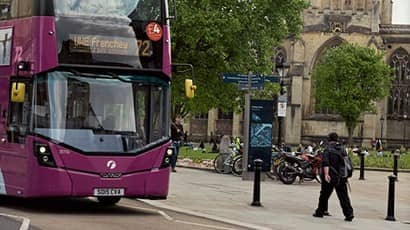
Trials of ‘demand responsive transport’ minibus services boosted connectivity for people in rural and suburban areas, according to a new report produced by UWE Bristol researchers.
Academics evaluated the impact of trialling demand responsive transport (DRT) services – where passengers can book shared minibus rides via an app or over the phone – in 18 parts of England.
In a report for the Department for Transport, the researchers said the new services were viewed as successful but there were question marks over funding as they do not always cover their costs and may require subsidies.
DRT services are aimed at improving social inclusion and access to services but can also contribute to reducing carbon emissions by replacing car journeys and linking users to a train station or a bus service.
The research team, led by Professor Kiron Chatterjee with Dr Eda Beyazit, examined the impact of services introduced by September 2024 funded by the Government’s £19.4m Rural Mobility Fund. It is the first time a detailed assessment of DRT scheme performance has been undertaken.
The DRT trial services – including one called the Robin in Gloucestershire – are flexible and provide shared transport to users who specify their desired location and time of pick-up and drop-off. Nearly all the services provided a ‘corner to corner’ service picking up and dropping passengers off at designated stops and new virtual bus stops. For some schemes it was possible to make live on-demand bookings while for other schemes bookings needed to be made at least one hour in advance.
The report said: “They [the trials] have shown that DRT can play a role in providing transport in rural areas under the existing regulatory structure, and that it is worth considering as one of the available options.
“DRT services were now operating, some in areas where there had previously not been any public transport, and they were providing connectivity and access to services for people. This was how most judged success.
“Bringing levels of journey subsidy to what was seen as acceptable (for each local authority) remained a major challenge. There were clear calls for greater consideration of social value in the economic assessment of DRT services in locations where local authorities felt they were never likely to fully cover their financial costs.”
The report added: “Local authorities reflected that their passengers were now able to make journeys they had not been able to make before, although there was some caution that, because of the need to aggregate passengers, these might take longer than using private transport.”

The data analysed by the researchers covered September 2020 – September 2024, although many of the schemes started later than September 2020.
Monthly passenger journeys in the latest six-month monitoring period of the trials averaged at 2,101 across the 18 schemes, the report said, with average passenger journeys per vehicle hour standing at just over two. The DRT schemes served areas ranging from four square miles to 337 square miles, with average journey distances varying from 2.3 to 10.2 miles.
Most journeys (87 per cent) were booked with the mobile apps, with phone bookings to a call centre constituting 11 per cent. The average advance booking time was 2.7 days. The longest duration that users can book in advance on the app – which allows users to track the progress of their vehicle – ranged from five days to 30 days.
In total, £1,654,530 in revenue was reported for 823,490 passenger journeys since the schemes started operating. This represents an average of £2.01 revenue per passenger journey but the true figure will be higher than this, because those local authorities participating in the fare cap scheme were unable to include reimbursements for this from central government in their figure.
The report said that user feedback volunteered via the app was largely very positive but there is a need to more systematically collect user feedback to capture the experience of all users.
Concluding the report, the authors said: “All the local authorities with pilots in operation by September 2024 have embraced the opportunity and have learnt from the experience. Many of those spoken to in this research were enthusiastic about future opportunities to either add to what is already implemented or to deploy further schemes across their areas.
“The Rural Mobility Fund pilots have been perceived as successful by the local authorities. This is generally due to the pilots providing an enhanced level of public transport access in the areas they serve.
“…Many of the local authorities saw DRT in the context of wider policy objectives for public transport, such as reducing car usage and providing equitable access to employment, education, health or leisure facilities for dispersed populations. Several local authorities made the point they would like to consider wider benefits when they are looking at the viability of funding of DRT schemes. Whilst not ignoring the need to optimise the delivery and operation of schemes, they argued it is not possible to effectively consider value-for-money for DRT without taking account of the social value created.”
Professor Chatterjee and the UWE Bristol research team recently ran a webinar called ‘Capturing the social value of DRT’ as part of a separate project on DRT funded by the Economic and Social Research Council. They presented results for three of the Rural Mobility Fund DRT schemes and are continuing this work in the next two years to more fully understand the social and economic benefits to rural communities.
Related news

20 April 2026
International study to explore how digital mobility apps could improve transport for women and caregivers
A new prototype mobility app that considers the barriers to transport faced by women and carers will be created as part of a research project co-led by a UWE Bristol researcher.

09 June 2025
Opinion: If you want trams, support the buses
Graham Parkhurst, Professor of Sustainability, Centre for Transport and Society, reacts to news of £800 million investment in the region's transport network.
29 November 2024
Bristol Clean Air Zone – two years on, what is the future of the CAZ?
Two years on, Professor Graham Parkhurst and Professor Jo Barnes comment on what the future of Bristol's Clean Air Zone looks like.

20 June 2024
Academic elected as President of Chartered Institute of Highways and Transportation
Professor Glenn Lyons has been announced as the new President for 2024 / 25.
28 November 2023
New report finds lack of transport choices is leaving young people behind
A new study warns that young people cannot access life-defining opportunities due to poor transport provision.
01 October 2023
UWE Bristol wins funding to develop safer autonomous vehicles
UWE Bristol has secured government funding for research into autonomous vehicles.
18 September 2023
One in 15 West of England residents use public e-scooters every month
UWE Bristol researchers have published the results of the West of England rental e-scooter trial.
14 June 2023
Researchers monitor autonomous bus user experience as UK's first zero emission service launches new route
Researchers monitor autonomous bus user experience as UK's first zero emission service launches new route.
31 May 2023
Enhanced junction designs “make it clear to drivers that they need to give way”
A research project has identified two side road crossing designs that encourage drivers to give way to people crossing and waiting to cross.
24 January 2023
UWE Bristol joins First Bus and partners to launch UK's first zero-emission autonomous bus service
The UK's first-ever zero emission autonomous bus service reached a key milestone with trials starting on public roads in Oxfordshire on Monday 23 January 2023.
17 January 2023
Panel poses key questions about future roads spending
Report published raising seven key questions to help guide for decision-makers achieve the best value from future roads spending.

28 July 2022
Unfair bus fares risk holding young people back
Research by UWE Bristol and transport charity Sustrans finds access to free and discounted bus fares for 16–24 year olds varies significantly across the UK.
You may also be interested in
Find an expert
Media contacts are invited to check out the vast range of subjects where UWE Bristol can offer up expert commentary.

Media enquiries
Enquiries related to news releases and press and contacts for the media team.

College of Arts, Technology and Environment
With over 12,000 students and 750 staff, our interdisciplinary approach to teaching, research and partnerships creates new opportunities for our students, our staff and the communities we serve.
Centre for Transport and Society (CTS)
More information about the Centre for Transport and Society, including research projects, transport courses, news, events and opportunities.