
Dementia support groups developed by professor adopted across globe


A programme started by a UWE Bristol academic to provide emotional and practical support for people with dementia is now being adopted around the world.
The Living Well with Dementia (LivDem) course, for small groups of people who have recently been diagnosed as having a form of dementia, has been introduced in Japan, Italy and Ireland following its success in the UK.
It was set up by Richard Cheston, Professor of Dementia Health, with an NHS colleague in 2010. The LivDem approach of holding group meetings supported by trained facilitators aims to help people to adjust following a recent dementia diagnosis.
The international expansion of this evidence-based, structured programme could reach South America next, with clinicians from Argentina and Chile expressing an interest in implementing the approach.
Professor Cheston said: “LivDem emerged from discussions with a colleague when we were both NHS clinical psychologists. At the time, we were each running groups for people living with dementia that focused on helping them talk about their diagnosis and the changes they were experiencing. We felt strongly that these conversations were important, and that the NHS needed to offer more opportunities for people to discuss their diagnosis openly.
“However, there were very few psychologists available to deliver such groups. This meant we needed to find a way to equip nurses, occupational therapists and social workers to facilitate them instead. LivDem was developed as a way of supporting the wider workforce to deliver psychologically informed group work for people who had recently been diagnosed with dementia.
“A key feature of LivDem is that the groups are only for people living with dementia. Family members and carers only attend a preliminary and follow up meeting. We felt this was important because the voices of people with dementia can easily become overshadowed when others are present. LivDem is designed to give people space to talk freely, in their own right, about their experiences.”
Several studies have been conducted to evaluate the benefits of the LivDem model – an eight-week course attended by groups of between six and eight people – including research examining changes in how participants talk about their diagnosis before and after attending the groups.
Professor Cheston said: “Participants often report that they initially feel hesitant to identify themselves as having dementia. Over time, attending LivDem helps this feel easier. By bringing people together to talk about the diagnosis, this helps people to feel that they are not on their own. This in turn helps them to feel a little less frightened by the diagnosis – and this is why they are able to talk more openly about it. This greater openness seems to have knock on benefits – for instance people are more socially active because they are not so concerned about keeping the diagnosis hidden or making mistakes.
“We think that for many people it makes relationships easier – it reduces the need for secrecy and avoidance. For many LivDem participants, this translates into a better quality of life and greater confidence in thinking about and planning for the future.”
"It is hugely rewarding to see these ideas being taken up in different countries and contexts. It is encouraging to know that work developed at UWE is having a meaningful impact internationally. "
Professor Richard Cheston

International interest in the LivDem approach has stemmed from practitioners around the world looking for new ways to talk openly about dementia with their clients or patients. They often find out about LivDem through professional networks, conferences, or online searches.
Professor Cheston, from UWE Bristol’s School of Health and Social Wellbeing, said: “It is hugely rewarding to see these ideas being taken up in different countries and contexts. It is encouraging to know that work developed at UWE is having a meaningful impact internationally. On a personal level, I have also greatly valued the opportunity to meet and learn from so many inspiring practitioners and colleagues around the world.
“Although dementia services differ widely across countries, the challenges dementia creates—the sense of uncertainty and existential threat—are universal. People living with dementia everywhere need opportunities to talk about what is happening to them. At its core, that is what LivDem offers – talking openly about dementia does not change the realities people face, but it can make those realities feel less frightening and more manageable.”
Over several years, Professor Cheston has worked with Dr Emily Dodd to further develop LivDem, creating a dedicated website and a structured training package for facilitators. They maintain links with group meeting facilitators in the UK and internationally, both to learn from their experiences and to support high-quality delivery of the intervention. The intervention has also been adapted for different contexts, and PhD student Jude McClellan has started work with the team to adapt LivDem for younger people (under 65s) who are living with dementia to ensure that it better reflects their life stage and experiences.
In addition, Dr Natasha Woodstoke has led a project – supported by the NIHR (National Institute for Health and Care Research) Applied Research Collaboration West – that applies LivDem principles to couple and family-based work. This has resulted in the development of LivDem-Families, an intervention designed to help families talk more openly about the diagnosis together. This is particularly important for people who cannot attend groups, or who wish to have these conversations within their family. Dr Woodstoke, working with Dr Karin Buschenfeld, has begun a trial of Families-LivDem in Bristol and Somerset.
Dr Woodstoke, a Research Fellow at UWE Bristol, said: “Dementia profoundly affects both the person who’s been diagnosed, and the people close to them. People react to a dementia diagnosis in different ways. We already know that LivDem can help diagnosed people adjust. Now, with further research and careful implementation, we hope that LivDem-Families will also help people whose loved one has had a diagnosis.”
At the end of last year, people living with dementia and their supporters came together with researchers and charity staff for a celebratory event of the LivDem approach. The event brought together people who had attended a LivDem group, their supporters and facilitators from Mindsong – a Gloucestershire charity that supports people with dementia and their families, and which delivers LivDem groups. Attendees shared their experiences of LivDem which were captured in a film.
There is more information about LivDem on the website. For enquiries about LivDem, contact Professor Richard Cheston, Dr Emily Dodd and the team on livdem@uwe.ac.uk
Related news
08 October 2026
Innovative new app created to help stroke patients with rehabilitation
A UWE Bristol researcher led a project to develop an innovative new app to help patients recover after having a stroke.

19 August 2026
Researcher to lead £455k body image project supporting people with head and neck cancer
A UWE Bristol researcher has been awarded almost half a million pounds to lead a project to develop a body image programme for people living with and beyond head and neck cancer.

16 July 2026
‘When I got the chance, I followed it with my heart’ – nurse graduates at the age of 64
An electronics technician who retrained as a registered nurse has graduated at the age of 64.
17 June 2026
Scientists develop low-cost tests for people with bleeding and clotting disorders
Patients with bleeding and clotting disorders living in low-income countries could benefit from new low-cost testing devices being developed at UWE Bristol.
15 June 2026
Researchers develop new approach for connecting people with substance use dependency to community support
UWE Bristol researchers have developed a toolkit to help people living with drug and alcohol dependency access community services that support their long-term health and wellbeing.

02 June 2026
International conference on body image and appearance research set to be staged in Bristol
Leading experts from across the globe are preparing to travel to Bristol for a major conference dedicated to body image and appearance research.

02 April 2026
Hypothermia rates halved in babies born before arrival at hospital, new research finds
Rates of hypothermia in babies born before arriving at hospital in the South West of England have halved over the last five years, according to a new evaluation by UWE Bristol researcher Dr Laura Goodwin.
02 April 2026
New NIHR Senior Investigator reflects modern research leadership
Professor Nicola Walsh, Professor of Knowledge Mobilisation and Musculoskeletal Health, has been announced as a Senior Investigator by the NIHR.
17 March 2026
Researcher develops new digital tool for people with anxiety disorders
A UWE Bristol researcher is developing a new digital tool to help people with anxiety disorders.
10 February 2026
Work by UWE Bristol lecturer features in Government’s National Cancer Plan
Work by a UWE Bristol academic has been included in the Government’s National Cancer Plan.
22 January 2026
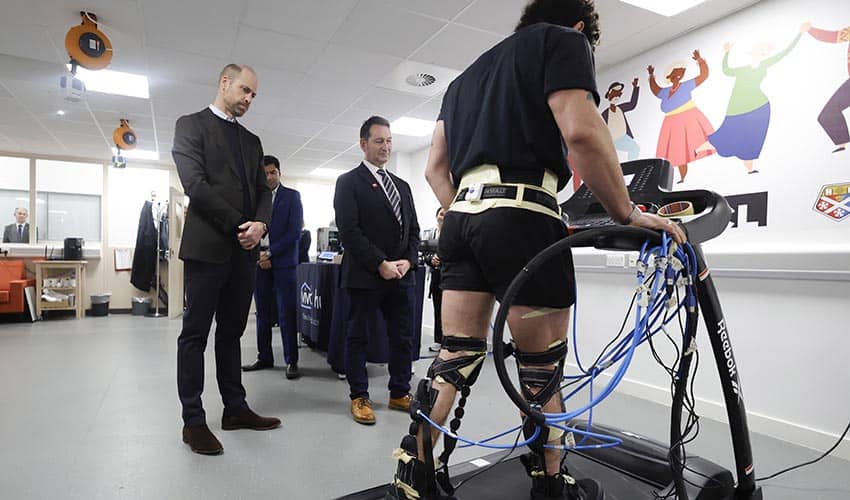
Prince of Wales visits UWE Bristol to see pioneering robotic tech tackling societal health challenges
The Prince of Wales visited the Bristol Robotics Laboratory (BRL) at the University of the West of England’s (UWE Bristol) Frenchay campus today (22 January 2026) to learn about the pioneering robotic technologies being developed to help the ageing and disabled population maintain mental and physical wellbeing and remain independent for longer.

17 December 2025
Findings revealed from first UK study into experiences of mothers who are survivors of rape pregnancy
UWE Bristol academics have revealed the findings of the first UK-based study of the experiences of mothers who are survivors of rape pregnancy.
You may also be interested in

Media enquiries
Enquiries related to news releases and press and contacts for the media team.
Find an expert
Media contacts are invited to check out the vast range of subjects where UWE Bristol can offer up expert commentary.

College of Health, Science and Society
The College of Health, Science and Society is a large, diverse and dynamic part of the University, bringing together experts from Health and Social Wellbeing, Applied Sciences, Education and Social Sciences.