
Prince of Wales visits UWE Bristol to see pioneering robotic tech tackling societal health challenges


The Prince of Wales visited the Bristol Robotics Laboratory (BRL) at the University of the West of England’s (UWE Bristol) Frenchay campus today (22 January 2026) to learn about the pioneering robotic technologies being developed to help the ageing and disabled population maintain mental and physical wellbeing and remain independent for longer.
Prince William met researchers and start-ups at the BRL, the most comprehensive academic centre for multi-disciplinary robotics research in the UK and a partnership between UWE Bristol and the University of Bristol, based at UWE Bristol’s Frenchay campus.
During the visit, the Prince of Wales toured the facilities in the BRL including meeting the research team at the VIVO Hub for Enhanced Independent Living, which is led by the University of Bristol, bringing together advanced robotic and digital healthcare technologies to pioneer new approaches to ageing and assisted living.
Carlos Cifuentes, Deputy Director of VIVO Hub and Associate Professor in Human-Robot Interaction at UWE Bristol, and Dr Andrew Conn, Professor of Robotics at the University of Bristol, along with researchers and PhD students, demonstrated some of VIVO Hub’s smart garments and exoskeletons that provide health monitoring, physical assistance and rehabilitation, helping to restore an active and independent life.
This includes robotic clothing that can help to prevent falls, support people to get up from a chair, climb stairs and walk for longer, and assist in developing daily activities with independence.
The Prince of Wales also met the founders of two start-ups working to improve the lives of people with disabilities and those living with dementia.
Supersmith is a technology company changing the way the world thinks about mobility scooters, based within the BRL’s hardware incubator, a space for high-tech enterprises to commercialise their business. Two of its three founders, Tom Morgan and Emily Morgan, demonstrated Supersmith’s 3Scooter, a three-wheeled scooter using unique self-stabilising robotic technology. Its design reduces the risk of tipping while enabling users to sit at eye level with those around them, breaking down the social stigma of using a mobility scooter.
Supersmith’s three founders have their own personal connection to the world of mobility. “We set out to improve the experience of living with a mobility scooter because of a close family member,” said Tom. “Listening to people’s stories showed us these challenges were shared nationwide. People aren’t avoiding leaving their home because they lack independence or ambition - for many people, a traditional mobility scooter just doesn’t make them feel good. With the help of our community, that’s what we are hoping to change.”

Finally, Zeke Steer, founder of Milbotix, a start-up revolutionising dementia care through advanced wearable technology, spoke to Prince William about SmartSocks®, his product which tracks heart rate and motion to provide an insight into the wearer’s wellbeing and determine when a person with dementia is distressed.
Zeke, a graduate of BRL’s joint PhD programme, started Milbotix after seeing his great-grandmother’s experiences of dementia and worsening agitation meaning she couldn’t be cared for by family. Zeke wanted to use technology to detect levels of distress in people with dementia that allows for quicker physical or psychological interventions, reducing stress for users and their caregivers.
Milbotix is based at Future Space, an innovation centre combining workspace, R&D expertise and tailored business support for start-ups and fast growth businesses on UWE Bristol’s campus.
Professor Darren Reynolds, Pro-Vice Chancellor for Research and Knowledge Exchange at UWE Bristol, said: “We’re so pleased to welcome the Prince of Wales to UWE Bristol’s campus today to see how our challenge-led approach can drive ideas from imagination to actual reality, leading to thriving start-ups within the Bristol Robotics Laboratory. These start-ups are addressing societal challenges that will improve people’s lives and power our economy.
“Prince William has seen first-hand our thriving community of tech-minded and solutions-focused entrepreneurs and researchers, reimagining tomorrow through robotics and the power of AI. At UWE Bristol’s Enterprise Zone, we are supporting over 70 high-tech start-ups working collaboratively, a place where knowledge, research, ideas, talent and imagination collide.
“Humans need the ability to reimagine - it brings us hope. We are in an exciting and pivotal moment for robotics and AI in the UK. We are now able to put technology at the heart of many solutions-focused endeavours to address some of the major challenges facing us all - be it healthcare, climate change or food security. Today, Prince William has been given a glimpse of tomorrow.”
Related news

11 September 2026
New book delivers decades of machine vision research into the hands of students, engineers and researchers
Practical Machine Vision: 2D, 3D and Deep Learning Systems for Real-World Applications is a new practical guide to machine vision that draws on almost three decades of research.
26 June 2026
Industry-led training showcased as Minister for Skills visits UWE Bristol
Baroness Jacqui Smith, Minister for Skills, visited UWE Bristol’s Frenchay campus (Thursday 25 June) to learn more about the breadth of skills programmes offered at the university that support future skills needs and drive regional growth.

18 May 2026
UWE Bristol graduating students present Showcase 2026
A design for a community-led regeneration of Fishponds and a film about migration and motherhood are just some of the projects to be featured in Showcase.
16 March 2026
Award win for mentoring scheme supporting women into male-dominated STEM careers
A mentoring scheme for women in male-dominated STEM fields created by UWE Bristol academics has been named Outstanding Programme of the Year at the inaugural Bristol Women in Business Awards 2026.
16 March 2026
West of England Mayor supports circular economy at UWE Bristol Repair Café
The Mayor of the West of England, Helen Godwin, attended UWE Bristol's free Repair Café event to meet staff, students and community volunteers.
07 July 2025
UWE Bristol named training provider of the year for closing engineering skills gap
UWE Bristol has been named Training Provider of the Year at the Enginuity Skills Awards for its commitment to driving inclusive growth in the engineering industry.

26 June 2025
Development of innovative Devon food processing centre to tackle food waste gets UWE Bristol support
UWE Bristol is supporting the development of an innovative food processing centre in Devon that will transform food waste management and support greater food sustainability.

21 May 2025
Students reveal creative responses to real-world experiences at UWE Bristol Showcase
UWE Bristol’s Showcase, celebrating student creativity and innovation across the College of Arts, Technology and Environment, returns this June.
03 April 2025
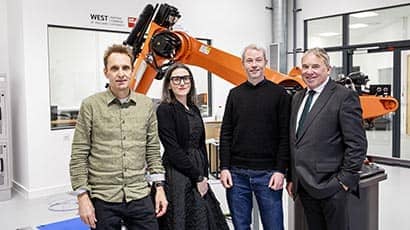
Interdisciplinary studio bridging the gap between creative industries and technology opens at UWE Bristol
A new £3.6m laboratory has opened at UWE Bristol which will provide a unique arts, humanities and technologies multi-disciplinary space for researchers, entrepreneurs and businesses across the West of England.
12 November 2024
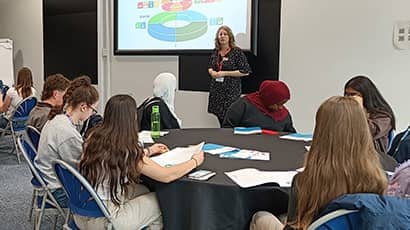
UWE Bristol to help inspire next generation of young people into green careers
UWE Bristol will play a key role in a new programme to educate more than 10,000 young people in the West of England about green skills and help them explore eco-friendly careers.
22 October 2024
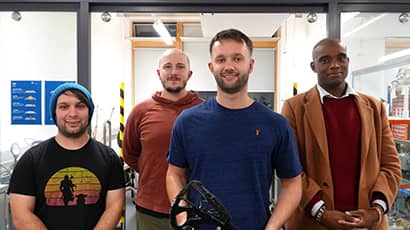
‘Life changing’ prosthetic leg developed at UWE Bristol to be trialled at global competition
Researchers from UWE Bristol are preparing to showcase an advanced bio-inspired prosthetic leg they have developed to improve the quality of life for people with above-knee amputations.
17 September 2024
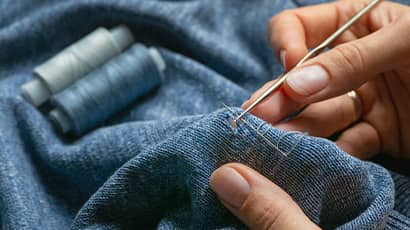
Repair Café returns to UWE Bristol’s School of Engineering
UWE Bristol’s Repair Café returns this autumn with a special ‘repairs skills day’ on 25 September, ahead of the café reopening monthly from 9 October.
You may also be interested in

Media enquiries
Enquiries related to news releases and press and contacts for the media team.
Find an expert
Media contacts are invited to check out the vast range of subjects where UWE Bristol can offer up expert commentary.
Harnessing creativity and technology
Harnessing creativity and technology to power economic growth, we're working with industry and the public sector to develop skills, talent, and innovation for the future economy.
College of Arts, Technology and Environment
With over 12,000 students and 750 staff, our interdisciplinary approach to teaching, research and partnerships creates new opportunities for our students, our staff and the communities we serve.