
Centre for Sustainable Planning and Environments (SPE)
The Centre for Sustainable Planning and Environments (SPE) aims to develop an understanding of how to achieve healthy, resilient, sustainable and smart places, in the context of climate and ecological emergencies.
We undertake challenge-led research that contributes to planning theory, policy and practice across three inter-related themes:
- Healthy places
- Sustainable and resilient places
- Smart cities.
We are also contributing to contemporary debates on ethics in planning practice and planning education.
Find out more about these themes and our research projects.

Research areas
An overview of our key research themes and interests.
Members
Our staff, students, and visiting professors.
Projects
Current and completed projects in our key research areas.
Partners
A list of SPE's collaborators and partners.
Postgraduate opportunities
Postgraduate opportunities in SPE.
Research seminars and podcasts
Hear more about the research from SPE.
Publications
Complete list of research publications from SPE members.
Centre enquiries
Contact information and how to find us.
Centre for Sustainable Planning and Environments blog
-
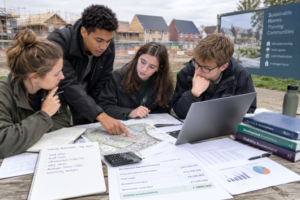
by Hannah Hickman Between 2019 and 2021, we led a study at the University of the West of England of 500 planning students studying in planning schools across universities in the UK and the Republic of Ireland. This research explored students’ motivations for studying planning and their expectations for future practice and was published in … Continue reading "Skills gaps in planning: why economic literacy matters"
Skills gaps in planning: why economic literacy matters
-

by Hannah McConnell Using spider webs to capture environmental DNA and designing plant-based structures to bring nature’s microbial richness indoors: these were some of the fascinating research projects showcased at UCL’s Bartlett School of Architecture in London, at the Probiotic Cities Symposium that took place in early September. The event brought together experts from urban … Continue reading "Probiotic cities "
Probiotic cities
-

By Sara Hayball and Michael Buser The relationship between ageing, lived experience, and the built environment is increasingly recognised as a critical concern for planners, designers, and public health practitioners. Yet the ways in which places are imagined and designed often continue to reflect narrow assumptions about who uses the space, how they move, and … Continue reading "Engaging People Living with Dementia in Place‑Based Research: Reflections from the World Health Organisation Healthy Cities Conference"
Engaging People Living with Dementia in Place‑Based Research: Reflections from the World Health Organisation Healthy Cities Conference
-

by Reem Elnady Last month, I attended the World Planning Schools Congress in Helsinki to present my PhD research on Muslim refugee women’s everyday experiences of integration in Bristol. A highlight of the trip was a mobile workshop on public libraries, visiting Oodi (Helsinki Central Library) and Sello Library in Espoo. These visits offered a … Continue reading "Reflections from Helsinki’s Public Libraries: Social Infrastructure and Everyday Integration"
Reflections from Helsinki’s Public Libraries: Social Infrastructure and Everyday Integration
-

by Dr Yarden Woolf, Prof Issy Bray, and Prof Danni Sinnett What can a single day of conversations tell us about the streets we live on, and the ones we want to create? At this year’s Festival of Nature, we spent the day listening. Listening to children imagining greener, brighter streets. Listening to adults reflecting … Continue reading "Listening to streets: reflections from the Festival of Nature"
Listening to streets: reflections from the Festival of Nature
-

Through movement, we explored how spatial codes and social norms shape our feelings, bodies, and presence in the city. by Elahe Karimnia On a pleasant day in June 2026, a group of women gathered in Bristol city centre to participate in Be-longing in Making Places, a movement-based workshop exploring belonging, visibility, and inclusion in urban … Continue reading "Making Place Through Movement: Exploring barriers to inclusivity in Bristol"
Making Place Through Movement: Exploring barriers to inclusivity in Bristol
-

By Sinead Ryan, Prof. Danielle Sinnett, Dr Isabelle Bray, and Dr Yarden Woolf During the UK’s Covid‑19 lockdowns, many aspects of everyday life were suddenly out of reach. People were separated from family and friends, routines were suspended, and familiar settings like pubs, workplaces, coastlines and swimming pools, became inaccessible. In an earlier analysis of … Continue reading "Missing places, reclaiming connection: what lockdown taught us about everyday spaces"
Missing places, reclaiming connection: what lockdown taught us about everyday spaces
-

by Sara Melasecchi Last October 2025, I was awarded some funding as part of the UWE Bristol’s Arts and Humanities Research Council (AHRC) Impact Acceleration Account (IAA) Rapid Response Fund 2025-2027. Here are some thoughts on my journey with this funding. This award represented the first time I led a research project; hence, it brought … Continue reading "Sharing research results and impact: My experience from the UWE Bristol’s Arts and Humanities Research Council (AHRC) Impact Acceleration Account (IAA) Rapid Response Fund"
Sharing research results and impact: My experience from the UWE Bristol’s Arts and Humanities Research Council (AHRC) Impact Acceleration Account (IAA) Rapid Response Fund
Transforming tomorrow, today.
Research Centres and Groups
You may also be interested in
The Bristol Planning Law and Policy Conference
The Annual Bristol Planning Law and Policy Conference organisers and sponsors, booking and registration.