
Sonamoni
Drowning prevention for newly mobile infants under two years in Bangladesh.
Project details
Full project title: Drowning prevention for newly mobile infants under two years in Bangladesh
Short project title: Sonamoni (Bangla for 'Little Pearl')
Duration: 2022-2026
Project lead for CPHWB: Professor Julie Mytton
Research partners/collaborators:
- Bournemouth University (Co-Lead organisation)
- Centre for Injury Prevention Research Bangladesh (CIPRB, Co-Lead organisation)
- Royal National Lifeboat Institution
- Southampton University
- Design without Borders
Funder: National Institute for Health and Care Research - Research and Innovation for Global Health Transformation (RIGHT) Programme
Project summary
Globally, drowning is a major cause of injury and death and Bangladesh has one of the highest rates of drowning in the world, especially among children. Drowning is the leading cause of child deaths for 1-17 year olds. Over the past 15 years, CIPRB has researched and implemented several effective drowning prevention solutions focused on children. Daily exposure to water represents a real drowning risk in Bangladesh, especially for rural preschool children. The risk of drowning in rural areas is twice that of cities due to high levels of poverty and easy access to water bodies.
Our intervention areas have significant numbers of ponds and ditches - natural drowning hazards for children aged 1 to 5 years - that drive drowning rates even higher. One project area (Kalapara) has one of the country’s highest rates of drowning. Caregivers have the constant challenge of providing supervision to small children whilst also working, preparing food, or undertaking household chores. This means that toddlers are often cared for by other young siblings. CIPRB has developed a successful community daycare model that reduces drowning rates in preschool aged children. However, our analysis shows that families are reluctant to allow children under 2 years to attend daycare.
We have planned an interdisciplinary project with six key phases to identify and test better ways to prevent newly mobile infants under 2 years old from drowning. We will work with communities in the north and south of Bangladesh to:
- build the skills needed by communities and our research partners to carry out this research in rural Bangladesh
- understand the challenges of keeping under 2s safe from drowning
- identify and prioritise possible solutions
- prototype solutions with designers and community members
- trial the best solutions in communities and evaluate them on use and maintenance, effectiveness, and ability to roll out the interventions across Bangladesh
- share the findings and make sure that the value of the solutions is not lost when the research project ends.
By working with communities in two distinct areas of in the north and south of Bangladesh, we will better understand how to roll out successful interventions for different circumstances and environments. Using an inclusive, human-centred design approach, we aim to identify the solutions that are most acceptable to communities, whose input will be central to the whole process.
We anticipate the findings from this research will inform a national drowning prevention programme run by Bangladesh’s Ministry of Women and Children’s Affairs, and other non-governmental policy and programme areas. In addition, findings will be relevant to preventing child drowning in other South-East Asian countries, where over 30% of global drowning deaths occur.
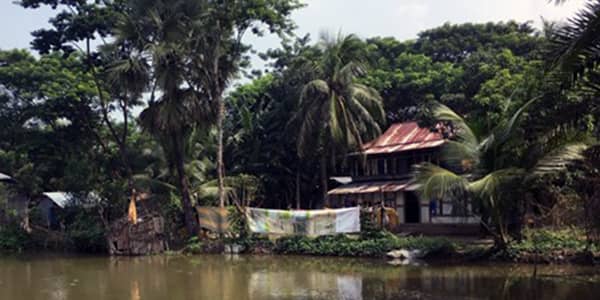
The above photo has been provided courtesy of Professor Julie Mytton.
Key output
Project contact
For further information about the project, please contact Professor Julie Mytton (julie.mytton@uwe.ac.uk).