
Disruptive technology to predict faults on train tracks and in stations


Train delays could be a thing of the past, thanks to a system that predicts when part of a train track, signalling equipment or other devices at a station are likely to fail. It does this by using thousands of sensors and 3D modelling that taps into big data.
The system, currently in development, will also allow engineers to use Augmented Reality (AR) via a smartphone or a Head Mounted Display (HMD) to locate failing components or structure faults and read on-screen instructions in real-time to help them with repairs.
The project is a collaboration involving the University of the West of England (UWE Bristol), smart engineering solutions company Costain and engineering technology start-up Enable My Team (EMT), which is the project lead.
A network of Internet of Things (IoT) sensors will initially be installed in 2019 in London Bridge Station, which is to be used as a test site. The sensors will gather data on tracks and station facilities, such as ventilation systems, barriers or lighting before sending it to a software called i-RAMP (IoT-enabled Platform for Rail Assets Monitoring and Predictive Maintenance).
The system will then use Artificial Intelligence (AI) techniques to analyse the data and to predict when a fault is likely to occur and highlights any stress points or component failures on a 3D virtual model of the station and tracks.
It is set for completion in April 2020, after which it will be trialled with selected customers for up to nine months. Five other train stations in the UK have been approached to serve as testing sites for the technology. The roll-out of the scheme is planned for 2021.
Professor Lukumon Oyedele, Assistant Vice-Chancellor, Digital Innovation and Enterprise, who is the principal investigator on the project at UWE Bristol, said: “Every day in the UK, production is adversely affected by the hundreds of hours lost through train delays, often caused by faulty signal boxes or broken tracks.
The system will enable companies to fix a problem before it even becomes one, and at a time when commuting is not disrupted, all thanks to the IoT sensors in the station and on the track.”
IoT sensors can transmit a whole variety of data including vibration, strain or pressure on a structure, humidity or temperature. Using several such components will enable train companies and station managers to monitor many parts of a train network at the same time.
Sandeep Jain, who is Founder & CEO at Enable My Team (EMT), said: "i-RAMP could bring reliability to the 1.7 billion annual passenger journeys on the UK railway, increasing productivity across the country. With machine learning and big data processing we can predict problematic vegetation, damaged structures and faulty signals, allowing repairs to be implemented before issues arise."
The system will also allow engineers to use Augmented Reality (AR) technology that offers them information about the location of faulty components and provide guidance on how to fix it. As well as orienting them to the exact place where the problem lies, it will also supply them with real-time instructions and warn of dangers when carrying out the repairs
Professor Oyedele said: “By wearing a headset or using their mobile phones, engineers can view instructions superimposed on the joint or electrical circuit that they are repairing or replacing. For instance it might give information or warnings about the presence of high voltage in a section of a control panel, or how to disassemble an electric circuit in a signal box in a safe way.”
Related news
09 October 2026
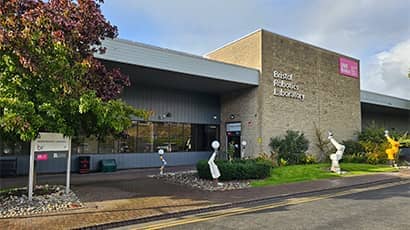
New £9.8 million robotics hub to benefit South West businesses
A new £9.8 million hub led by the Bristol Robotics Laboratory will help organisations across the region realise the productivity, resilience, and growth benefits of robotics and automation.

14 September 2026
Immersive Arts announces £8.5m second phase funding
Immersive Arts has secured over £8.5 million to continue supporting UK artists working with immersive technologies until 2030.

27 July 2026
North Wales to host major UK immersive arts event ‘The Big Thing’
Artists, producers and technologists will gather in Llandudno in September as a national event exploring the future of immersive arts heads to North Wales.

08 July 2026
Researchers develop guidance to tackle ‘high carbon’ advertising on London’s transport network
Researchers have answered the Mayor of London’s call for guidance regarding a possible ban on the advertising of ‘high carbon’ products and services on the capital’s public transport network.
07 July 2026
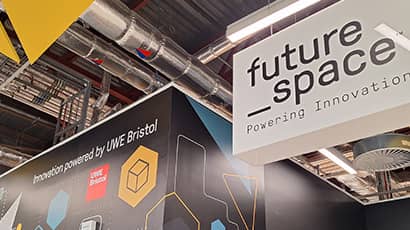
UWE Bristol’s innovation centre Future Space contributes £56 million to the economy over the last 10 years
UWE Bristol innovation centre for high-tech businesses is celebrating a decade of impact after generating more than £136 million in investment and contributing £56 million in GVA to the economy.

01 July 2026
Volunteers experience life as wild animals for pioneering nature conservation project
A group of volunteers experienced life as if they were wild animals for an innovative nature conservation project co-led by UWE Bristol.
18 June 2026
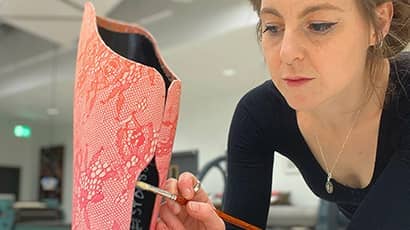
‘It allowed me to embrace my disability rather than hide it’ – print experts create prosthetic leg cover for bride
Print experts from UWE Bristol developed an innovative solution for a bride-to-be – by creating a bespoke covering for her prosthetic leg to match her wedding outfit.

17 June 2026
Scientists develop low-cost tests for people with bleeding and clotting disorders
Patients with bleeding and clotting disorders living in low-income countries could benefit from new low-cost testing devices being developed at UWE Bristol.

15 June 2026
Researchers develop new approach for connecting people with substance use dependency to community support
UWE Bristol researchers have developed a toolkit to help people living with drug and alcohol dependency access community services that support their long-term health and wellbeing.
19 May 2026
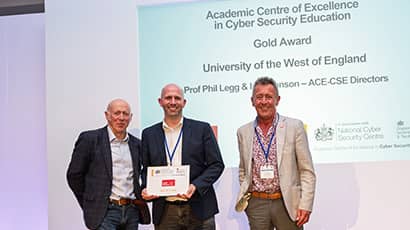
UWE Bristol’s gold award for cyber security education renewed for further three years
UWE Bristol’s Gold Academic Centre of Excellence in Cyber Security Education (ACE-CSE) status has been renewed by the National Cyber Security Centre (NCSC).

20 April 2026
International study to explore how digital mobility apps could improve transport for women and caregivers
A new prototype mobility app that considers the barriers to transport faced by women and carers will be created as part of a research project co-led by a UWE Bristol researcher.

31 March 2026
More than 140 UK projects receive over £2 million in second Immersive Arts funding round
Over £2 million has been allocated to 142 artist-led projects across the UK in the second round of Immersive Arts funding.