
New research reveals villain casting damages real-world attitudes to visible difference


New research by UWE Bristol shows that people who are exposed to visible difference via negative villainous characters in the media go on to have a more negative perception of people with visible differences in the real world.
This is the first time evidence has shown that negative media portrayals can directly worsen attitudes to visible difference.
The new study, published in the British Journal of Health Psychology, was a randomised controlled trial involving 103 participants, randomly assigned to view positive, negative or neutral portrayals of people with visible differences. Those shown negative portrayals showed a statistically significant increase in appearance-related stigma, while positive and neutral portrayals produced no such effect.
Appearance-related stigma was measured using an adapted version of the Perceived Stigmatisation Questionnaire, asking participants how they believed they would behave around someone with a visible difference, including whether they would stare or behave kindly. Higher scores indicated greater stigmatising behaviour.
Nearly four in ten (39 per cent) people with a visible difference say they have seen someone who looks like them cast as the villain, compared with just one in five (20 per cent) who have seen a character like them cast as the hero, and 15 per cent who have seen someone like them as the love interest. Some 4.9 million people in the UK have a visible difference.
Dr Ella Guest, a Senior Research Fellow at UWE Bristol’s Centre for Appearance Research and part of the team carrying out the study, said: “Anecdotally, we've known for a long time that when visible differences are used as character tropes to signal to audiences that someone is a villain, this has an impact on people's attitudes towards those with visible differences, perpetuating stigma.
“It's really useful to have findings from this experiment that clearly demonstrate that effect and can help make the case for change in how people with visible differences are presented in TV and film.”
In response to the research findings, a petition has been launched calling for production companies, broadcasters and casting directors to ‘balance out’ the negative impact of portraying people with visible difference as villains in film and television.
Changing Faces, a charity supporting everyone with a scar, mark or condition on their face or body, launched the petition ahead of Halloween when these negative media portrayals are rife. They are calling on the media industry to introduce more positive characters with visible difference – a call backed by 61 per cent of the public who, when surveyed, they said they want to see more people with visible differences represented in popular culture.
"Anecdotally, we've known for a long time that when visible differences are used as character tropes to signal to audiences that someone is a villain, this has an impact on people's attitudes towards those with visible differences, perpetuating stigma."
Dr Ella Guest, a Senior Research Fellow at UWE Bristol’s Centre for Appearance Research
The petition also calls for better data collection on representation to measure progress. Changing Faces has worked with the Creative Diversity Network to include visible difference as a category in its Diamond workforce diversity data monitoring and reporting platform alongside current categories covering age, disability, ethnicity, gender, sexual orientation and religion or belief. Through this collaboration, the UK television industry is now able to effectively monitor and measure the representation of visible difference for the first time, including the portrayal of people with this characteristic on screen.
Louise Wright, Chief Executive of Changing Faces, said: “For years we've asked the industry to think about the stories it tells about visible difference. Now, for the first time, we have proof that those stories don't stay on screen – they shape how people with visible difference are treated in real life. Halloween is the moment this is impossible to ignore, which is why we're asking industry, and the public, to help us change it.
“Our campaign has already led to visible difference being monitored across broadcast media outlets. The data collected over the coming years will be used to influence more inclusive practice – a huge milestone for our community. We now need to build on this momentum and show the media industry why representation needs to urgently change.”
Actor Robert Rhodes, whose credits include Silent Witness, 28 Years Later, House of the Dragon and, most recently, The Rapture, said: "We can’t wait for action any longer. The media industry needs to start reflecting the true experience of people with visible difference – yes there is often trauma associated with a scar, but we experience joy, love and success just like everyone else. More neutral and aspirational characters on screen will improve real perceptions of the whole visible difference community.”
The petition can be signed at https://action.changingfaces.org.uk/. It will be sent to broadcasters, streamers, production companies and casting bodies including the Casting Directors' Guild.
Related news
19 August 2026
Researcher to lead £455k body image project supporting people with head and neck cancer
A UWE Bristol researcher has been awarded almost half a million pounds to lead a project to develop a body image programme for people living with and beyond head and neck cancer.

02 June 2026
International conference on body image and appearance research set to be staged in Bristol
Leading experts from across the globe are preparing to travel to Bristol for a major conference dedicated to body image and appearance research.
16 July 2025
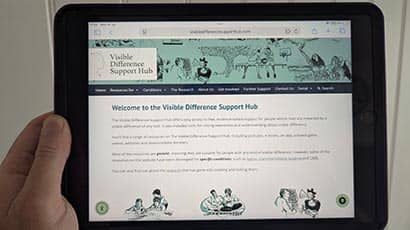
Researchers launch support hub for people with visible differences and their families
A first of its kind website offering evidence-based psychological support for people with visible differences and their families has been launched by university researchers.
30 January 2025
Women exercising in gyms face barriers including body image and harassment, study finds
Women exercising in gyms often feel judged for their appearance and performance, leading to a persistent sense of inadequacy, according to a new study.
15 November 2024
Global body confidence education project supported by UWE Bristol reaches 20 year milestone
A global initiative supported by UWE Bristol to build body confidence and self-esteem for the next generation of young people has celebrated its 20th anniversary.
24 May 2024
Impact of world-leading Centre for Appearance Research celebrated on 30th anniversary
It has grown from two researchers and a PhD student to become what is considered the largest research centre in the world focussed on appearance and body image. Now the Centre for Appearance Research (CAR) has celebrated its 30th anniversary.
22 May 2024
Psychology researchers set to stage world’s only international conference on appearance and body image
Researchers from UWE Bristol are getting ready to stage the world’s only international conference focused on issues around appearance and body image.
16 August 2023
New director appointed at UWE Bristol’s Centre for Appearance Research
UWE Bristol has appointed Professor Elizabeth Daniels as Director of its Centre for Appearance Research.
22 September 2021
Global study looks to improve lives of individuals with congenital condition
A major five-year study led by researchers at UWE Bristol and Seattle Children’s Hospital looks to improve care for people with craniofacial microsomia.
08 July 2021
World-leading conference to explore the impact of COVID on body image
Leading academics from around the world will meet next week to discuss how the COVID pandemic has affected issues around body image and appearance.
28 June 2021
Researchers seek 2,000 young people for new study into appearance and body image
Researchers at the Centre for Appearance Research (CAR) at UWE Bristol are looking for young people to take part in a research about body image.
26 May 2021
Somali people with visible facial differences sought by researchers for new study
Researchers at the Centre for Appearance Research (CAR) are looking for Somali people to take part in a new research study.
You may also be interested in
Media enquiries
Enquiries related to news releases and press and contacts for the media team.
Find an expert
Media contacts are invited to check out the vast range of subjects where UWE Bristol can offer up expert commentary.
Research
Our active, collaborative research community of bold, original thinkers break boundaries, immerse themselves in the now and open the way to new futures.
Centre for Appearance Research (CAR)
High-quality and innovative research that creates and promotes knowledge and understanding about the psychosocial and cultural aspects of appearance.