
UWE Bristol secures £774,300 to equip future civil engineers with digital construction skills


Civil engineering students at the University of the West of England (UWE Bristol) will gain hands-on experience with technologies including collaborative robots, drones, and large-scale 3D concrete printing, following a £774,300 investment from the Office for Students (OfS).
The funding will enable the university to create new industry-focused digital construction facilities, giving more than 600 civil engineering students and apprentices practical experience of the automation, digital and advanced technologies transforming the construction sector.
The investment supports UWE Bristol’s ambitions to power the future workforce, strengthen regional skills and deliver innovative, practice-led education.
The new facilities and equipment will include high-performance computing, specialist digital engineering software, collaborative robotics, drone-based reality-capture technologies, digital surveying equipment, Extended Reality (XR) technologies and large-scale concrete 3D printing. These technologies will support Building Information Modelling, digital twins, AI-enabled engineering analysis, automation, infrastructure monitoring, and digital fabrication.
The project will create a distinctive digital construction learning environment that integrates civil engineering, automation, robotics and advanced manufacturing technologies. Students will benefit from greater access to specialist facilities, authentic project-based learning and engagement with technologies increasingly used by employers.
Dr Marianthi Leon, Associate Professor and Associate Director of Smart and Sustainable Infrastructures, said: “Our Civil Engineering programme was one of the first in the UK to introduce the automation and digital innovation strand, and our desire has always been to secure the hardware to match our ambition. This funding allows us to do that. Our students, full-time and part-time, and our degree apprentices will learn construction automation the way the industry is beginning to practise it: applying collaborative robots, printing in concrete, surveying with drones and LiDAR, and instrumenting real structures to calibrate digital twins.
“These are capabilities employers tell us they struggle to recruit. The construction sector is moving towards increasingly automated and data-driven ways of working, and our graduates will enter the industry already familiar with the technologies helping to drive that change.”
Professor Ramin Amali, Dean and Head of School of Engineering, said: “The direction of travel for civil engineering and construction is clearly towards greater automation, AI and digital delivery. The RICS 2026 report shows that around two-thirds of construction respondents now use AI in some part of their work, up from just over half a year earlier.
“This reinforces the need to equip civil engineering graduates with strong digital, AI and automation skills alongside their core engineering knowledge. Securing this funding will be instrumental in advancing our core agenda of developing future-ready graduates with the skills, knowledge and capabilities to succeed in an increasingly digital and automated industry.”
The £774,300 award forms part of £84.5 million in capital funding being distributed by the OfS for 2026/27. The funding is designed to improve students’ skills, knowledge and career opportunities as well as deliver a boost to national growth and regional economies.
Projects competing for the latest round of funding had to address the government’s national strategy and priority sectors for growth and meet the needs of local employers and regional economies, as identified in Local Skills Improvement Plans or Skills England’s priorities.
David Smy, OfS’s Deputy Director of Enabling Regulation, said: “Having access to brand new, or vastly improved facilities means that students’ learning, both now and in future generations, will be greatly enhanced. This substantial investment is helping to drive economic growth and, above all, will enable students to acquire the advanced range of skills they will need in today’s workplaces.”
Related news

18 November 2026
From smart walkers to robot helpers: Bristol researchers develop pioneering technology to support independent living
As the BRL celebrates 20 years of pioneering robotics research, two PHD researchers are exploring how robotics and AI could transform everyday life.

17 November 2026
UWE Bristol’s Dr Sofie Boons named one of the UK's 50 Future Innovators
An Associate Professor has been named on a new list compiled to highlight people whose innovative work is changing lives.

10 November 2026
UWE Bristol secures funding to develop computers made from proteins

06 November 2026
Health initiative for male sex workers led by UWE Bristol researcher wins prestigious award
A co-produced digital health initiative led by a UWE Bristol academic designed to improve access to HIV prevention, sexual health information and wellbeing support for male sex workers has been recognised with a prestigious award.

03 November 2026
Graduate wins ‘Green Oscar’ for sound production
A UWE Bristol graduate who discovered post-production sound while studying at the university, has won one of wildlife filmmaking’s most prestigious awards.
28 October 2026
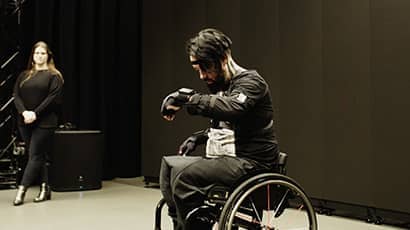
Technology used widely in entertainment and health sectors is failing disabled people, study finds
A major technology used widely across the entertainment and healthcare sectors is failing to serve disabled people, a new study led by UWE Bristol has revealed.

26 October 2026
UWE Bristol professor brings Cary Grant home to Bristol in celebration of the city's film heritage
Charlotte Crofts, Professor of Cinema Arts, will welcome audiences from across the UK to Bristol for the seventh edition of the Cary Comes Home Festival.
22 October 2026
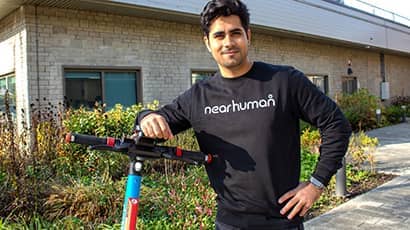
UWE Bristol graduate leads startup focused on improving e-scooter safety
A startup founded by a UWE Bristol graduate has secured £350,000 from investors to develop new technology to improve e-scooter safety.

09 October 2026
UWE Bristol Fine Art graduate wins prestigious painting prize
Charli-Ann Padilla’s painting was chosen from a shortlist of 12 undergraduate student artists from across the UK to win the Freelands Painting Prize.

08 October 2026
Innovative new app created to help stroke patients with rehabilitation
A UWE Bristol researcher led a project to develop an innovative new app to help patients recover after having a stroke.

14 September 2026
Immersive Arts announces £8.5m second phase funding
Immersive Arts has secured over £8.5 million to continue supporting UK artists working with immersive technologies until 2030.

11 September 2026
New book delivers decades of machine vision research into the hands of students, engineers and researchers
Practical Machine Vision: 2D, 3D and Deep Learning Systems for Real-World Applications is a new practical guide to machine vision that draws on almost three decades of research.
You may also be interested in

Media enquiries
Enquiries related to news releases and press and contacts for the media team.
Find an expert
Media contacts are invited to check out the vast range of subjects where UWE Bristol can offer up expert commentary.