
Technology used widely in entertainment and health sectors is failing disabled people, study finds


- Motion capture technology generates distorted representation of disabled people’s bodies, researchers discover
A major technology used widely across the entertainment and healthcare sectors is failing to serve disabled people, a new study led by UWE Bristol has revealed.
Motion capture technology, which turns a person’s movement into digital data, is often associated with precise measurement. However, the research found that the technology generates a distorted representation of disabled people’s bodies or leaves them completely excluded.
The findings of the study highlighted that disabled people face barriers wherever motion capture technology is being used – from capturing actors’ performances for inclusion in films and video games, to the creation of avatars in virtual reality, the analysis of athletes' technique, and the measurement of patients' mobility in hospitals and rehab clinics.
Academics examined the technology with a group of disabled artists (musicians and dancers), building on recent research showing that today’s motion capture technology rests on assumptions about bodies drawn from mid-20th-century military research.
Dr Dominic Potts, a lecturer in computer science at UWE Bristol, said: “Disabled people are largely encountered by these systems as patients to be measured and corrected, rather than as performers, gamers or creators.
“We found that motion capture systems are not neutral recording devices. They are built around narrow assumptions about the structure and motion of bodies, which shape the models used in today's commercial systems. The result is that when a body doesn't match the template, the system doesn't adapt, the body is made to fit.
“All individuals using motion capture systems are forced into a standardised body. Some people fit the template better than others, but for physically disabled people, this often results in barriers to use or dramatic distortions in how they are represented.”
Of the wider implications of the project’s findings, Dr Potts said: “It has potentially high-stakes consequences in clinical contexts. It could be misdiagnosis or it could be doing more harm during rehabilitation processes. This is all speculative at this stage and it needs further exploration.
“When it comes to disabled actors in films or video games, or disabled gamers being able to use motion capture in virtual reality: without significant investment in time and augmenting the technology to fit their needs, they won't be able to use it.”
For the project, the researchers worked with disabled dancers and musicians from Candoco and Dyskinetic. They all encountered barriers with existing motion capture systems.
Dr Potts, who works in the mica lab at UWE Bristol’s The Bridge Studios, added: “This kind of exclusion of disabled people is pervasive, so it was entirely unsurprising for the artists. They ended up leaving with a different perspective about how technology could be designed differently. The technology doesn't have to inherently exclude them - it can be designed in a way to include people from the beginning.”

Another research lead for the project, Clarice Hilton, from University College London’s Slade School of Fine Art, commented on why the shortcomings of motion capture technology had been overlooked for so long: “It says something about wider attitudes towards disability in society; accessibility is often an afterthought. Disabled people are rarely involved in the design of technology, and the technology can look very different if you centre disability from the outset.”
To address the issues identified in the study, the research team has set out four ‘grand challenges’ - a practical agenda for how academic research and the motion capture industry could build motion capture systems differently.
Professor Tom Mitchell, a UK Research and Innovation Future Leaders Fellow who leads the mica lab at UWE Bristol, commented: “A big focus of the work that we do in the mica lab is to consider the wider context of how different people and technology come together. There's a clear demand for more equitable and accessible technology to be developed more generally.
“There are 1.3 billion disabled people on the planet, and everybody is temporarily disabled at some point in their life. So there’s a huge proportion of people in the world who are excluded from using technology, because so little of it is developed responsibly, by which I mean thinking early on about who it might leave out and involving those people in its design.
“These are open problems for academia and industry alike. I hope our grand challenges will serve as a call to action to build on this research and to design more accessible motion capture systems going forward.”
An academic paper covering the project was presented at ASSETS 2026, the leading international conference on computing and accessibility, in Portugal earlier this week where it has been awarded an honourable mention. The paper came from a project called EqualMotion, which was funded by MyWorld/Innovate UK with additional support from a UKRI Future Leaders Fellowship, bringing together UWE Bristol, University College London, Goldsmiths University, x-io Technologies, MiMU Gloves, Candoco and Dyskinetic to co-design an inclusive wearable motion capture system.
Research collaborator Kris Halpin, from Dyskinetic, said: “For me, the power of the EqualMotion project came in actually having the choice to fully explore my Disabled body as a creative, expressive tool. Previous technologies, in their inaccessibility, send the wrong message that motion capture (as a creative tool) is not for Disabled people - it is not for my body.
“The project brought emotional weight as I was able to fully see and explore my Disabled body’s quirks and limitations in a digital space, but through that wide range of emotions came ultimately a sense of empowerment; permission to explore my body creatively as it is, without judgement or barriers.”
The team have put together a video about the project.
Related news

26 October 2026
UWE Bristol professor brings Cary Grant home to Bristol in celebration of the city's film heritage
Charlotte Crofts, Professor of Cinema Arts, will welcome audiences from across the UK to Bristol for the seventh edition of the Cary Comes Home Festival.
22 October 2026
UWE Bristol graduate leads startup focused on improving e-scooter safety
A startup founded by a UWE Bristol graduate has secured £350,000 from investors to develop new technology to improve e-scooter safety.
09 October 2026
UWE Bristol Fine Art graduate wins prestigious painting prize
Charli-Ann Padilla’s painting was chosen from a shortlist of 12 undergraduate student artists from across the UK to win the Freelands Painting Prize.
08 October 2026
Innovative new app created to help stroke patients with rehabilitation
A UWE Bristol researcher led a project to develop an innovative new app to help patients recover after having a stroke.
14 September 2026
Immersive Arts announces £8.5m second phase funding
Immersive Arts has secured over £8.5 million to continue supporting UK artists working with immersive technologies until 2030.

11 September 2026
New book delivers decades of machine vision research into the hands of students, engineers and researchers
Practical Machine Vision: 2D, 3D and Deep Learning Systems for Real-World Applications is a new practical guide to machine vision that draws on almost three decades of research.
10 August 2026
Graduate photographer breathing life into Weston-super-Mare’s own identity
A graduate photographer from Weston-super-Mare has created a 'love letter' to his home town to shine a light on struggling coastal communities.
27 July 2026
North Wales to host major UK immersive arts event ‘The Big Thing’
Artists, producers and technologists will gather in Llandudno in September as a national event exploring the future of immersive arts heads to North Wales.
03 July 2026
UWE Bristol strengthens international wildlife filmmaking links at Wildscreen Festival Kenya
UWE Bristol played a key role at Wildscreen Festival, Kenya, bringing together established and aspiring filmmakers, educators, and industry professionals.
02 July 2026
Postgraduate Art and Design students showcase personally-inspired work
Discover emerging talent at UWE Bristol’s MA Showcase at Spike Island, with art and design work spanning illustration, photography and more.
18 June 2026
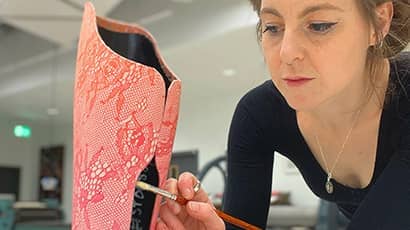
‘It allowed me to embrace my disability rather than hide it’ – print experts create prosthetic leg cover for bride
Print experts from UWE Bristol developed an innovative solution for a bride-to-be – by creating a bespoke covering for her prosthetic leg to match her wedding outfit.
17 June 2026
Winners at RTS Student Television Awards
UWE Bristol students have won four categories at a national competition celebrating the best audiovisual work from university filmmakers.
You may also be interested in

Media enquiries
Enquiries related to news releases and press and contacts for the media team.
Find an expert
Media contacts are invited to check out the vast range of subjects where UWE Bristol can offer up expert commentary.
College of Arts, Technology and Environment
With over 12,000 students and 750 staff, our interdisciplinary approach to teaching, research and partnerships creates new opportunities for our students, our staff and the communities we serve.

The Bridge Studios
The Bridge Studios at UWE Bristol is a state of the art creative space for physical-meta production.