
New book delivers decades of machine vision research into the hands of students, engineers and researchers


Researchers from the University of the West of England (UWE Bristol) are developing a new practical guide to machine vision that draws on almost three decades of research and real-world experience at the University's Centre for Machine Vision (CMV).
Practical Machine Vision: 2D, 3D and Deep Learning Systems for Real-World Applications, by Professor Lyndon N. Smith and Professor Wenhao Zhang, will be published in February 2027 by CRC Press, part of Taylor & Francis.
Rather than treating machine vision and artificial intelligence primarily as theoretical subjects, the book is designed around a simple principle: learning by doing.
It will take readers from the fundamentals of image formation, sensing and conventional image processing through 2D and 3D machine vision to modern deep-learning techniques, before showing how these technologies can be brought together to create complete working systems.
The book draws extensively on research undertaken at the CMV, where researchers have been developing machine-vision technologies since the mid-1990s. Over that period, they have worked on applications spanning agriculture, healthcare, biometrics, security, transport, environmental monitoring and industrial automation, with research contributing to vision systems deployed in real-world settings internationally.
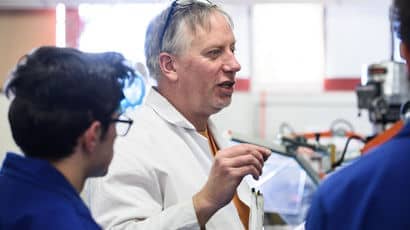
Professor Lyndon Smith, Director of the CMV, said: "One of the main things we have learned from many years of research is that successful machine vision is about much more than choosing the latest AI algorithm. You need to understand the whole system - what you are trying to measure, how you acquire the images, the lighting, the optics, the computing and the algorithms, and how all these elements interact.
"We wanted to capture that experience in a book but also make it genuinely practical. Our aim is that readers don't simply learn about machine vision - they actually build systems, run them, evaluate their performance and understand why they work."
Professor Lyndon Smith, Director of the CMV
A distinctive feature of the book will be its use of real research projects as case studies. These show not simply the final algorithms, but the engineering decisions, practical constraints and lessons involved in moving from an initial idea towards a working vision system. Selected projects will be presented in sufficient detail for readers to reproduce complete pipelines themselves, supported by datasets and working code.
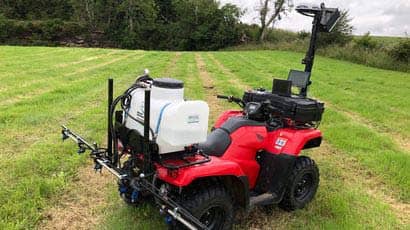
Examples range from deep-learning systems for detecting weeds in grassland and monitoring livestock, to medical imaging, 3D measurement and industrial applications. The book also examines emerging technologies including vision transformers, foundation models, vision-language models, explainable AI, hyperspectral and event-based imaging, neural radiance fields and multimodal sensing.
Professor Wenhao Zhang, Co-Director of the CMV, said: "Machine vision is developing extraordinarily quickly, particularly through advances in deep learning and AI. But there remains a major gap between demonstrating an algorithm on a dataset and creating a robust system that works reliably in the real world.
"The book combines rigorous academic foundations with practical implementation. We hope it will give students, researchers and engineers both an understanding of the technology and the confidence to apply it to new problems."

Another central feature of Practical Machine Vision is its emphasis on accessibility. Readers will be shown how increasingly capable vision systems can be constructed using affordable hardware, including Raspberry Pi-based platforms, rather than requiring expensive laboratory equipment.
Hands-on projects will take readers through the complete process of building a system - including image acquisition, data preparation and annotation, model training, performance evaluation and deployment. Accompanying software, datasets and other resources will be made available through a public GitHub repository.
This approach reflects one of the central messages of the book: advances in cameras, embedded computing and open-source AI have made sophisticated machine vision increasingly accessible. What was once largely confined to specialist research laboratories and major industrial installations can now be explored and implemented using relatively inexpensive hardware.
Professor Smith added: "Some of the most useful knowledge we have accumulated through our research has come from discovering what doesn't work, as well as what does. Real-world images are messy. Lighting changes, objects move, biological subjects vary, cameras become dirty or misaligned, and systems have to continue operating outside the controlled conditions of a laboratory.
"That practical experience is difficult to obtain from a conventional textbook. We want readers to benefit from what we have learned and then use those ideas to develop machine vision systems of their own."
The book is intended for engineers and practitioners working in machine vision, imaging, robotics and automation, as well as researchers and postgraduate students in computer vision and artificial intelligence. It is also designed to provide a foundation for MSc and PhD projects, allowing readers to take the supplied systems and extend them in new directions. The manuscript identifies engineers and practitioners, researchers and postgraduate students, and professionals applying vision in areas such as agriculture, medicine, security and industry as its principal audiences.
Practical Machine Vision: 2D, 3D and Deep Learning Systems for Real-World Applications is currently in development and will be published by CRC Press/Taylor & Francis in February 2027.
Related news

13 November 2025
New AI research to revolutionise animal welfare
A UWE Bristol research project will combine behavioural science and AI to create technology that understands not only what animals do, but how they feel.

26 November 2020
UWE Bristol's Centre for Machine Vision receives funding for augmented reality picking aid
UWE Bristol’s Centre for Machine Vision team, with other members of a consortium, have been awarded Innovate UK funding to develop a low cost, augmented reality picking aid for farm workers.

20 March 2019
Facial recognition technology aims to detect emotional state in pigs
Machine vision experts at UWE Bristol and Scotland's Rural College (SRUC) are developing a tool to monitor animals faces, alerting farmers to problems.
You may also be interested in

Media enquiries
Enquiries related to news releases and press and contacts for the media team.
Find an expert
Media contacts are invited to check out the vast range of subjects where UWE Bristol can offer up expert commentary.

Centre for Machine Vision (CMV)
Find out more about how the Centre for Machine Vision is a major research collaboration between UWE Bristol and the University of Bristol.
Automated farming systems
We are improving agricultural standards while saving costs and reducing environmental damage, with the introduction of automated farming systems for monitoring cattle welfare and crop production.