
Natural browsing opportunities can support donkey welfare, research finds


Access to hedgerows and a greater variety of vegetation allows donkeys to choose from different plants and carry out natural feeding behaviours, according to new research from UWE Bristol and The Donkey Sanctuary.
The new peer-reviewed study, jointly funded by the charity and the university, explored how donkeys at the charity’s Sidmouth site interact with native hedgerow species.
UWE Bristol PhD researcher Jessie Fitts found that donkeys showed clear preferences for feeding on leaves, twigs, shrubs and woody plants, and readily incorporated woody vegetation into their feeding behaviour, highlighting the value of providing opportunities for browsing alongside traditional grazing.

These findings highlight the benefits of the innovative browsing structures, dubbed 'whirligigs', featuring donkey-safe branches such as hazel and willow, often with added herbs, which have been introduced across The Donkey Sanctuary's sites. The structures provide foliage variety and opportunities to browse while also offering valuable mental stimulation.
Enrichment is a vital part of the charity's donkey care management, providing mental stimulation, preventing boredom and encouraging physical activity - all of which support good welfare and healthy weight management.
A re-design of the paddock for the resident miniature donkeys included adding tracks, building earth mounds, and re-seeding areas with diverse grass and wildflower mixes. Additional trees were also planted creating sheltered areas and spaces allowing donkeys greater privacy and control over their environment.
By monitoring how donkeys interact with their environment, researchers are building a stronger evidence base for enrichment and welfare. The findings complement a previous paper by Jessie, also funded by The Donkey Sanctuary, which found that donkeys in more diverse fields showed more positive emotional states.
Jessie said: “Our research explores how more diverse environments impact both donkeys and the land. Across three studies, we have found that fields of greater habitat variety improve donkey welfare. Browsing specifically is an important part of their diet and providing access to hedgerow species allows donkeys to carry out species-specific behaviours. We hope to offer an evidence base for donkey husbandry and land management, so owners and keepers can take advantage of the mutual benefit between a mix and variety of habitat and donkey welfare.”
Hannah Bryer, Head of Welfare at The Donkey Sanctuary, said: "We're continually exploring practical ways to create environments that allow donkeys to express a broader range of natural behaviours, giving them greater autonomy over their choices throughout their day.
"Monitoring how donkeys use their environment is helping us understand what works well, where improvements can be made and how enrichment can be tailored to best meet their needs.
"What's particularly exciting is that the benefits of this work extend far beyond our own farms. Many of our guardians as well as private owners, care for donkeys in similar-sized environments, so the knowledge we gain can help promote good welfare for donkeys in homes around the world.
"Enrichment also benefits the people who care for donkeys. Our grooms, volunteers and guardians build incredibly special bonds with these animals, and seeing donkeys able to explore, browse, interact and make choices within their environment is rewarding for everyone involved. It's a really exciting time for donkey welfare, and we're proud to be helping lead the way."
The Donkey Sanctuary hopes its ongoing research will help inform future best practice and create environments that support not only donkeys' physical needs but also their behavioural and emotional wellbeing.
Related news
12 August 2026
UWE Bristol researcher helps develop pioneering Avon Bioregion River Charter
A University of the West of England (UWE Bristol) academic has helped develop a bioregional charter of rights, to protect the River Avon.
08 July 2026
Researchers develop guidance to tackle ‘high carbon’ advertising on London’s transport network
Researchers have answered the Mayor of London’s call for guidance regarding a possible ban on the advertising of ‘high carbon’ products and services on the capital’s public transport network.
01 July 2026
Volunteers experience life as wild animals for pioneering nature conservation project
A group of volunteers experienced life as if they were wild animals for an innovative nature conservation project co-led by UWE Bristol.

23 June 2026
UWE Bristol awarded £233k for project working with children to develop water efficiency solutions
UWE Bristol been awarded £233,000 for a project that will see researchers work with children across the UK to explore their ideas for sustainable water use.

12 June 2026
Lessons from Yemen: building community resilience and hope in one of the world’s most fragile settings
A pioneering UWE Bristol project is empowering communities in Yemen to protect Al-Qahira Castle and strengthen climate resilience.

28 April 2026
Filmmaking students win award at inaugural NAHEMI–UK Green Film Network Competition
The third-year student film ‘Save Our Seas’ received The UK Green Film Network Award for Best Environmental Messaging.
01 April 2026
UWE Bristol leads £1m research into agricultural pollution in River Wye
UWE Bristol has been awarded £1 million to lead research into agricultural pollution in one of the UK’s most historic and ecologically significant river systems.
16 March 2026
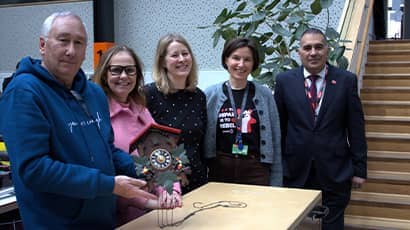
West of England Mayor supports circular economy at UWE Bristol Repair Café
The Mayor of the West of England, Helen Godwin, attended UWE Bristol's free Repair Café event to meet staff, students and community volunteers.
27 January 2026
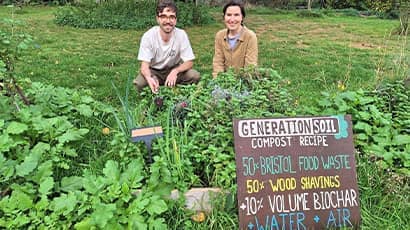
From scraps to soil: the UWE Bristol alum transforming campus food waste into fertile compost to feed university garden
A UWE Bristol alum has gone back to his roots to transform food waste from his former university into living, nutrient-rich compost to feed back into its student and staff-run Community Garden.
23 January 2026
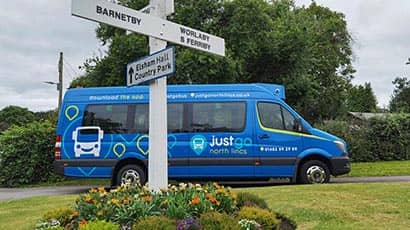
On-demand minibus services beneficial in rural areas but face financial challenges, trials suggest
Trials of ‘demand responsive transport’ minibus services boosted connectivity for people in rural and suburban areas, according to a new report produced by UWE Bristol researchers.
20 January 2026
UWE Bristol becomes South West Regional Hub lead for national Climate Ambassadors scheme
UWE Bristol is the new regional hub lead for the Climate Ambassadors scheme, a national initiative helping to drive the development of climate action plans in education settings across England.
15 December 2025
UWE Bristol rises eleven places in People & Planet University League
UWE Bristol has risen to 14th in the People & Planet University League (UK), a jump of eleven places.
You may also be interested in

Media enquiries
Enquiries related to news releases and press and contacts for the media team.
Find an expert
Media contacts are invited to check out the vast range of subjects where UWE Bristol can offer up expert commentary.