
Findings from study suggest Government guidance on smartphones in schools may not go far enough


A Government decision to leave interpretation of new smartphone policy guidance to individual schools has been questioned by new research from UWE Bristol academics.
From 1 September this year, schools have been expected to follow statutory guidance requiring them to have policies that prohibit pupils’ access to and use of mobile phones throughout the school day, except where an authorised exception applies. However, the Government has left it up to schools themselves to decide how to implement this in practice.
While some schools have adopted more restrictive approaches, such as storing phones in lockable magnetic pouches or lockers, or even banning smartphones from school premises, others have stuck with their 'phones switched off and in bags' policies, sometimes putting in place stronger enforcement measures throughout the school day.
However, findings from a study by Dr Benjamin Knight and Dr Paul Redford have highlighted several challenges associated with enforcing an 'off and in bags' policy, raising questions about whether the Government guidance ought to be tightened to exclude this option for schools.
The study, funded by the Nuffield Foundation, involves analysis of survey data collected from 3,721 secondary school pupils and 352 secondary teachers on smartphone use in schools in Bristol and the surrounding area in 2025.
The research showed some pupils found ways to circumvent the ‘off and in bags’ rules before the new legislation came into force - including secretly using their devices in toilets, under tables, via earbuds or smart watches, by hiding a phone on school premises or switching it to silent mode.
In addition, the study found that enforcement of smartphone policy was a substantial and uneven burden on school staff. Nearly two-thirds of staff (64.7 per cent) reported actively enforcing smartphone rules at least weekly, while 29.3 per cent did so daily or at least once per lesson.
Dr Knight, an Associate Professor in Education, said: “Our data shows how porous the ‘phones off and in bags’ policy was and how vulnerable to circumvention it was by a significant minority of young people. It didn’t stop smartphone use – it changed how and where it happened.”
In their survey responses, students admitted they primarily circumvented the policy through concealment and reduced visibility. Staff reported the same pattern: 79.8 per cent observed use in hidden/less monitored areas, 61.3 per cent observed toilet visits to use phones and 58.9 per cent witnessed phones being kept hidden and silent rather than switched off.
Dr Knight said: “Toilets were the most common location for phone use outside lessons, reported by 82 per cent of students. But it is perhaps not surprising that young people would come up with fairly elaborate displacement behaviours to make sure they could stay in touch with their peer group online and in touch with what's happening.”

On the impact on staff of the ‘off and in bags’ policy, Dr Redford, an Associate Professor, added: “Any time spent enforcing smartphone rules is time spent focusing on something other than the lesson they are teaching. Smartphones featured prominently in behaviour incidents: one in three members of school staff estimated that they were involved in at least a quarter of the incidents they dealt with.”
The researchers warned that school leaders would be likely to face challenges in successfully introducing more restrictive policies (e.g. magnetic pouches, phone lockers or outright bans), predominantly because young people were strongly opposed to restricting their access to smartphones. The study showed that 93.5 per cent of pupils wanted either the status quo (‘off and in bags’) to remain in place, or to have fewer or no restrictions.
Dr Knight said: “School leaders should prepare for some turbulence if introducing tighter restrictions, as there is likely to be pushback and subversion from some students. They aren't going to be preaching to the choir about this, so they should think carefully about how it is introduced, what the messaging is and how it's rolled out.
“Strikingly, the students who least wanted stricter rules on phones were the pupils who saw themselves as struggling most academically. They were also more likely to report breaking their school’s existing smartphone rules - school leaders should be aware of that.
“These findings suggest that even introducing stricter ‘no access’ policies may not be enough to guarantee a smartphone-free school day. Schools need to think carefully about how their policies are understood, implemented and supported, particularly among pupils who may already be struggling. New rules will need to be introduced and enforced in ways which are sensitive to the scale of change this new policy represents for some young people.”
Dr Redford, from UWE Bristol’s School of Education and Childhood, added: “Because the Government has not said ‘You must create smartphone-free school days by using this or that particular strategy’, schools have got to judge what is going to work best for them.
“Our findings indicate that ‘off and in bags’ was not working as a restrictive policy before the new rules were introduced. It will be interesting to see whether schools can enforce this approach more successfully to meet the new government expectations that pupils do not have access to the phones during the school day.”
Related news

13 July 2026
Emotional graduation for mature student who collects degree after mother’s death
A mature student whose mother passed away three months before he completed his degree has graduated in an emotional ceremony.

11 June 2026
Research study identifies best ways to encourage weaker readers to take up reading for pleasure
Young children who struggle with reading would be more inclined to read for pleasure if they were offered books that matched their interests, a UWE Bristol study has found.

23 April 2026
UWE Bristol researchers expand their work on smartphone use among young people
Academics who conducted the most comprehensive survey of its type on smartphone experiences and school policy in the UK have expanded their research work.
23 April 2026
Young researchers launch children’s microfibre book to celebrate Earth Day
School pupils from Bristol, Luton and Pembrokeshire have helped create a new children’s book exploring airborne microfibres, after taking part in pioneering research with UWE Bristol.
01 April 2026
UWE Bristol receives highest possible grade after inspection of international teaching qualification
Teacher training delivered by UWE Bristol for trainee teachers working at schools overseas has been given top marks following a government inspection.
29 September 2025
Smartphone use hitting struggling pupils hardest, major study finds
Young people struggling with their studies at school are much more likely to have negative experiences on their smartphones than their better performing peers, a major new study has found.

09 September 2025
Project Zulu choir celebrates another record-breaking tour
Nearly £37,000 was raised during three unforgettable weeks of the 2025 Project Zulu choir tour – setting a new fundraising record since the tour began.
03 February 2025
Groundbreaking UWE Bristol project based on children’s lived experiences of racism in the UK set to transform police training
UWE Bristol researchers have worked with over 1,000 primary-aged children to explore everyday experiences of racism to inform future police training.

15 January 2025
Pupils’ work produced in anti-racism lessons to be displayed at Bristol Cathedral
Work produced by school children in response to specially designed lessons on anti-racism will go on show at an exhibition at Bristol Cathedral.
26 April 2024
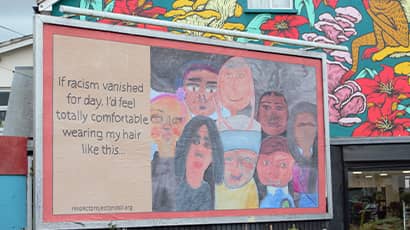
New billboard to encourage conversations about what life might be like without racism
The billboard displays an illustration from the book ‘If Racism Vanished for a Day’, which explores the impact of racism on children's wellbeing.

22 January 2024
New teaching resources to tackle under representation of Black British voices in the classroom
A new educational project, which aims to remove barriers to teaching Black British literature in schools, will be officially launched this month.
26 July 2022
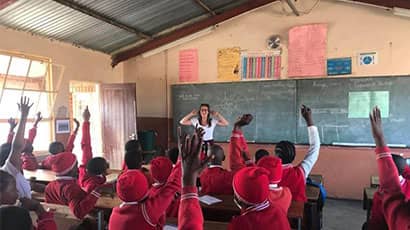
Technology, education, sports and filmmaking students to volunteer in South African townships
Students from UWE Bristol are travelling to South Africa this summer to volunteer in township schools in KwaZulu-Natal Province.
You may also be interested in

Media enquiries
Enquiries related to news releases and press and contacts for the media team.
Find an expert
Media contacts are invited to check out the vast range of subjects where UWE Bristol can offer up expert commentary.

Research
Our active, collaborative research community of bold, original thinkers break boundaries, immerse themselves in the now and open the way to new futures.

School of Education and Childhood
The School of Education and Childhood at UWE Bristol is a vibrant community committed to enhancing and transforming the lives of our students, and the children, young people and adults they work with.